II. Cello Through the Floorboards

A single, discarded sheet of music lay face down on the floor of the hallway, a white rectangle of paper crinkled at the corners and heavy with a few drops of condensation. It had drifted there from an open door, the notes—dark and dense like skeletal remains—curled toward the baseboard where the shadows were deepest.
Elena stood on the threshold of her own apartment, her palm pressed against the doorframe to steady the slight tremor in her hand. The transition from her studio’s controlled atmosphere to the communal corridor felt like stepping into a different pressure zone. The air here was thinner, smelling of floor wax and the faint, lingering ozone of an approaching evening.
Behind her, the silence of the painting remained, but the silence before her was vibrating. It wasn't just the absence of sound; it was the ghost of that cello's low frequency, a hum that seemed to have soaked into the drywall and stayed there, clinging to the surface like pollen.
She moved forward. Her bare feet made no sound on the carpeted runner, but her internal pulse was loud, a thrumming beat in the hollow of her throat. Every step toward the neighbor's door felt like an erosion of the boundary she spent her days maintaining with pigments and varnish. She was an analyst of decay; she knew how to preserve things, how to keep them separate from the world’s touch. Yet here she was, drawn toward the very thing that had disturbed her sanctuary.
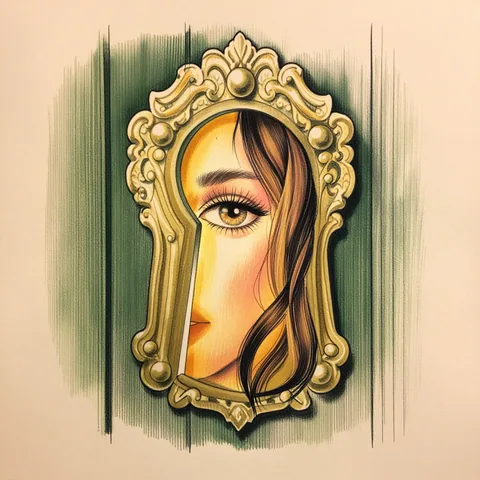
She stopped at the door across from hers. It was a heavy, dark wood, slightly ajar by a sliver less than an inch. From within, a low light bled into the hall—a warm, amber glow that made the dust motes dance.
And then there was the scent: rosin and old wood, sharpened by a trace of something herbal and masculine.
She didn't knock. The proximity felt too intimate for a formal summons. She pushed the door open just enough to see him.
Julian sat in a high-backed chair, his silhouette framed against a large window where the twilight was deepening into bruised violet. He was leaning back, one arm draped over the side of the chair, the other hand resting on his thigh. The cello sat between his knees, its body a deep, polished mahogany that reflected the amber lamp light.
He turned his head toward her. The movement was slow, deliberate. He didn't startle. Instead, his eyes—dark and heavy with a weary kind of focus—settled on hers. He wore a white button-down shirt, the top few buttons undone to expose the corded muscles of his neck. His sleeves were pushed up past his elbows, revealing forearms where the tendons moved like wires beneath fair skin.
"The music," he said. His voice was a low resonance, less a sound and more a physical texture that seemed to settle against her skin. "It carries through the walls better than I’d like. I hope it wasn't too intrusive."
Elena found herself taking a half-step into his space. The floorboards groaned ever so slightly under her weight. "It didn't feel like an intrusion," she said, her voice steady despite the way her chest felt tight. "It felt... intentional."
Julian smiled, a small, lopsided movement of the mouth that didn't reach his eyes entirely—it was more of a recognition of a shared secret. He shifted in the chair, the wood of the cello creaking against its stand.
"I'm Julian."
"Elena." She looked at the instrument. "You play with a very specific weight. I can hear the tension in the strings, even when they aren't moving. It’s not just the notes; it’s the way you hold the silence between them."
Julian watched her expression, his gaze lingering on her face before dropping to her hands—specifically her left thumb, where the small blue ink stain marred the olive skin.
"You have the hands of someone who works with delicate things," he observed. He gestured toward the hallway behind her, then toward his own workspace. "I saw you through the glass when I was tuning earlier. You’re meticulous."
"I restore art," she clarified. The words felt formal, a shield of professionalism she threw up instinctively. "It requires a certain... level of observation. You have to see the microscopic fractures before they become irreparable."
He stood then, and Elena felt the shift in the room's gravity. He was taller than she had imagined from the doorframe alone. His frame was broad, the lean musculature of a man who lived in his body, not just his mind. He moved with a controlled grace that made her want to take a step back and a step forward at once.
He stepped toward her, closing the remaining gap until he was within her personal orbit. He smelled of cedarwood and the slight metallic tang of string wire.
"Art restoration," he repeated, the words rolling off his tongue with a slow appreciation. "Preserving the ghost of what was there. I suppose that's what music is, too. Trying to keep a feeling from vanishing the moment it's finished."
He reached out, his hand moving toward the cello to adjust its position. As he gestured, his arm moved through the narrow space between them. The fabric of his sleeve brushed against her linen shirt—a brief, fleeting contact of cotton on linen.
Then, his hand moved closer. He reached toward her side, gesturing toward the wall they both shared.
"It's a strange thing, how sound travels," he murmured. "I can feel your apartment through the floor. Sometimes, I think it creates a kind of... phantom dialogue."
His hand didn't just pass her; his fingers brushed against hers.
The contact was light—a mere grazing of skin—but the sensation was violent in its precision. His fingertips were calloused, the pads roughened by years of pulling against heavy strings. When his skin met hers, Elena felt a jolt that started at the point of contact and radiated upward, settling in the marrow of her arm. It wasn't a spark; it was a grounding, a sudden, sharp awareness of the physical world.
The heat from his hand stayed behind after he pulled away. Her thumb, still marked with that blue ink, felt strangely hypersensitive, the skin buzzing as if it had been struck by a tuning fork.
Elena watched his hand move back to the cello. His fingers stayed there, poised against the strings, the callouses prominent against the dark wood.
"You're trembling," he said softly.
He wasn't looking at her face anymore. He was watching her hand.
She didn't pull it away. She couldn't. The air between them had thickened, becoming heavy and saturated with the same intensity as his music. She realized she was holding her breath, her lungs still full of the air of his apartment. The controlled sanctuary of her studio, her meticulously curated solitude, felt miles away.
She looked up at him, her hazel eyes narrowing as she tried to regain the footing of her own composure. "It’s the vibration," she lied, the words tasting dry in her mouth. "I'm still feeling the resonance from the last movement."
Julian’s gaze moved back to hers. His expression shifted, the guarded neutrality softening into something hungrier, more focused. He didn't move toward her, but he didn't retreat. He stood in the amber light, a man who knew exactly how to pull at a string until it reached its highest, most aching note.
"The resonance," he said, his voice dropping an octave, "doesn't just stop because you want it to, Elena. Sometimes it lingers until it finds somewhere to land."
He stayed there, watching her, the silence between them no longer empty but heavy with the weight of everything they hadn't said. Elena felt the pulse in her thumb again, a steady, rhythmic thrum that matched the ghost of the cello in her bones. She was no longer looking at a neighbor; she was looking at the source of the vibration, and for the first time in years, she didn't want to fix the fracture—she wanted to see how far it went.