I. No Trail on the Map
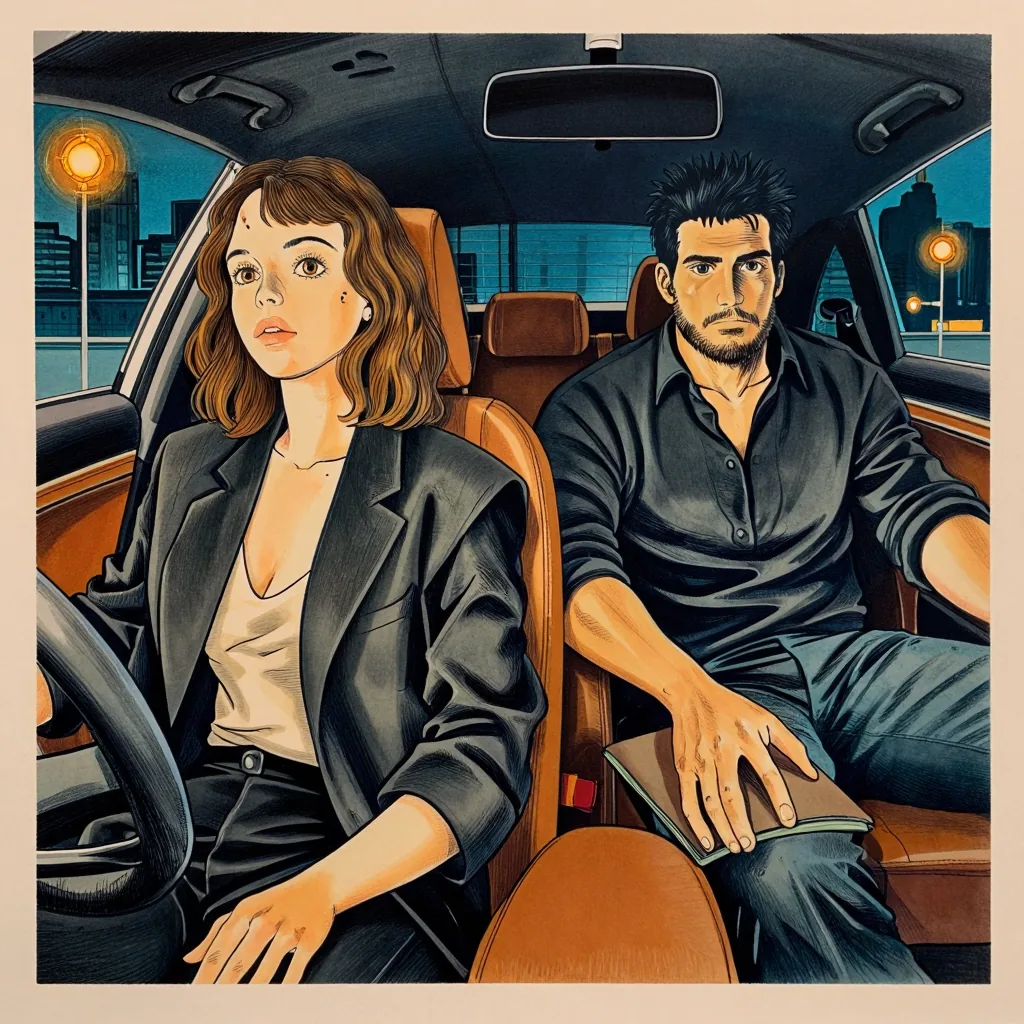
The humidity of the city sticks to the leather upholstery, making the air in the cabin thick enough to taste. I keep my eyes on the road, my hands at ten and two.
Roman sits in the backseat. He occupies the space like a mountain moved into a small room, his broad shoulders nearly touching the door frames. He hasn't moved a muscle since the ride began.
I watch the reflection of his face in the rearview mirror. A faint scar cuts through his right eyebrow, breaking the symmetry of a face that looks like it was carved from stone.
"Where to?" I ask. My voice sounds thin against the low hum of the tires on the asphalt.
"The warehouse district," he says. His voice is low, sandpaper-dry. "Turn left on 4th."
I pull a sharp left. The streetlights sweep across his face, highlighting the sharp line of his jaw and the way his dark hair falls over his forehead in messy strands.
The turn signal blinks twice.
"Actually, make it a right."
He speaks before I can process the first instruction. I slow the car, the tires groaning against the pavement as I veer into a narrow side street. The GPS on my dashboard pings, protesting the detour.
I look at my phone mounted on the dash. A blue pin appears, then vanishes.
"Change of plans," he says.
He leans forward slightly. His hand enters my periphery—large, pale, with knuckles that look like they've seen more than a desk job. He reaches for the phone.
I see his thumb tap the screen. The destination pin flickers and dies.
"The pier," he says. "Go back toward the bridge."
He doesn't wait for me to acknowledge. He’s watching the map now, his thumb scrolling with a fast, jerky motion that suggests impatience.
I find myself gripped by a tightening in my chest. I shouldn't care about the route. It's a cash-only ride; his privacy is his own. But the way he deletes the pins—fast, repetitive—makes my skin prickle.
He wants to move without a trail.
A shift in his weight makes the car tilt. He settles back into the leather. I catch a glimpse of something tucked into the crease of the backseat between him and the door.
It's a heavy manila folder. It sits slightly ajar, revealing the edge of a document with a red header. A black staple bites into the corner of the page.
He hasn't opened it since he sat down, but the weight of it seems to hang between us. It feels like a live wire in the back of the car.
I navigate a turn onto an industrial bypass. The shadows here are long, cast by skeletal buildings that look like ribcages against the moon.
"The old shipyard," he says again.
I glance at the phone. The pin is gone for the third time. He's rerouting me through a labyrinth of dead ends and loading docks.
The silence in the car changes. It’s no longer just the absence of talk; it’s a pressurized thing, the kind that happens right before a storm breaks.
I keep my eyes on the road, but my peripheral vision is locked on the mirror.
Roman turns his head.
He isn't looking at the street anymore. He’s looking straight at me, his dark eyes locking onto mine in the reflection. The steady gaze holds mine for three seconds, four, five.
His face remains expressionless, but he leans into my space, just enough that I can feel the heat of him from across the seats.
"You're a good driver," he says.
The compliment feels like a warning. I don't know if he’s praising my skills or my willingness to follow his lead into the dark.
"I'm just doing my job," I say, my throat dry.
He doesn't blink. He just watches me, a shadow in the backseat with a secret folder and a destination that keeps shifting like sand.
I press my foot firmer on the gas. The car accelerates into the gray of the shipyard, moving away from the lights of the city.