I. The Quiet Toast
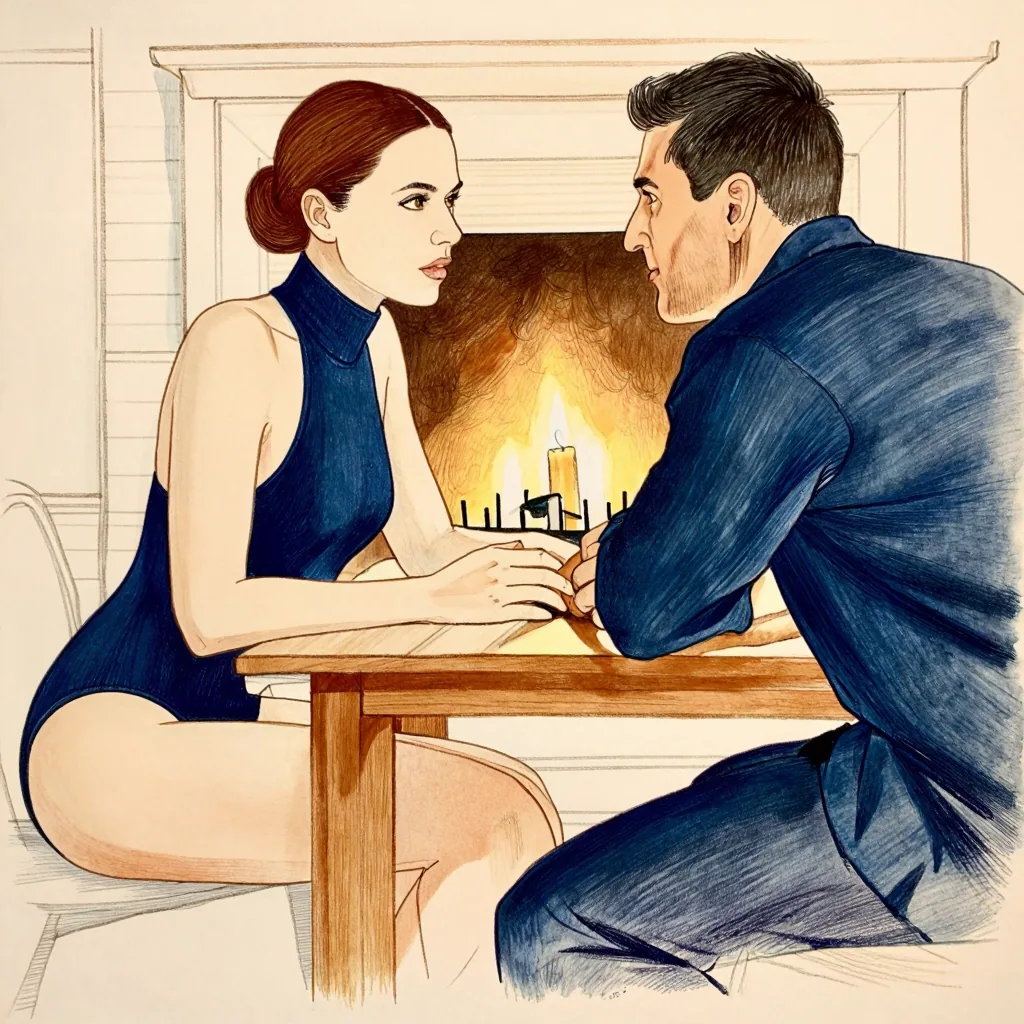
The condensation on my wine glass leaves a damp ring on the linen. Across from me, Marcus sits in the half-light of the dining room, his shadow stretching long against the far wall.
Maren is in the other room, likely already asleep. The house is too quiet, the kind of silence that makes the hum of the refrigerator sound like a roar.
I shift my weight, the navy swimsuit fabric smooth against my skin under the silk wrap. The air smells of salt and charred rosemary. I take a sip of the Cabernet, the tart fruit coating my tongue.
Marcus doesn't look away. His eyes stay on me, tracking the movement of my throat as I swallow. He leans back, one arm draped over the chair’s spine.
"The tide is coming in fast tonight," he says. His voice is low, barely carrying across the table.
I don't answer immediately. I watch his hand, fingers long and steady. He isn't looking at the window. He’s watching the small mole just above my lip.
I set the glass down with a soft *clink*. The sound feels too loud in the vacuum of the room.
"I can hear it," I say. My voice sounds steady, though my pulse is a dull thrum against my collarbone.
Marcus stands up. He doesn't do it quickly. He moves with a heavy, grounded ease that makes the floorboards groan ever so slightly. He walks around the table, his movements fluid.
He reaches for the wine decanter. I can see the faint scar across his eyebrow as he tilts his head toward the bottle.
As he leans in to pour, his arm brushes mine. The contact is brief—the rough linen of his sleeve against my bare shoulder—but it sends a sharp jolt through me. I flinch, just enough for my glass to rattle against the table.
He pauses, the decanter hovering. He doesn't pull back.
"You’re shivering," he says. There is no judgment in his tone, only a flat statement of fact.
I look up at him. He is close enough now that I can smell the cedar and sea salt on his skin. His thumb rests on the neck of the bottle, inches from my hand.
"It's a drafty house," I lie.
His eyes drop to my mouth. The air between us feels thick, heavy with the weight of things we aren't saying. I should stand up. I should find a reason to leave the room, to go to my own bedroom and lock the door.
Instead, I stay seated. I watch his chest rise and fall in a slow, rhythmic motion.
He sets the bottle down. He doesn't move to return to his chair. His hand moves from the decanter to the table, his knuckles white against the wood.
"Maren thinks we’re just enjoying the peace," he says.
The name feels like a transgression in the space between us. I think of her—our years of shared secrets, the way we used to plan our futures over cheap coffee. It feels like a different life, a story someone else told.
I lean back slightly, my spine pressing into the chair. "She thinks a lot of things."
Marcus reaches out. He doesn't grab me; he just rests his hand on the table between our chairs. His palm is upturned, an invitation in the dim light.
I look at his hand, then back at his face. The friendship rules—the invisible lines we drew years ago—have been erased by the isolation of the beach and the heat of the candles.
"She's not here right now," he says.
The honesty of it is a physical weight. I know what happens if I move toward him. I know the wreckage that follows.
I reach out. My fingers touch the side of his hand, his skin warm and slightly rough.
The dinner is over, but the evening hasn't begun. The house is still quiet, but the silence has changed shape. It isn't a lack of sound anymore; it's the pressure of everything we're about to do.